This is my first article written in English so, please, excuse me for any syntax or grammar mistakes. Its' first version was written in Greek by me, when i was sixteen years old, and since it was well-received, i translated it in English as well.
I don't mind you reposting in, but keep in mind that I will sue whoever will use it to make profit without refering to this blog.
I would be glad to get informed about any mistakes and have them corrected. :)
-------------------------------------------------------------
Seeking for a theory of everything
Over the last decades, physicists have been seeking for a theory of everything, a theory via which the existence of all kinds of forces and material in our universe will be explained in the same context, emerging from some fundamental equations and laws. Some experts consider such a theory to be non-existent. On the other hand, physicists, while trying to find a theory of everything, have developed theories that seem to not only interpret nature in all its' levels using the same maths, but reply to one of the most critical questions of physics, and mankind in general: why is nature as it is? Pure luck, some kind of superior power working in mysterious ways or it just couldn't be different?
Most attempts to develop a theory of everything failed dismally. The problem with such a theory is that the cornerstones of physics, quantum mechanics and theory of relativity, are utterly inconsistent with one another but a theory of everything has to unify them. Quantum mechanics is about the sub-atomic level while the theory of relativity is a model regarding the behaviour of large-scale cosmic structures and space-time. Both theories make highly precise predictions and are sufficient for what they regard -quantum mechanics the behaviour of subatomic particles and the interractions between them and relativity the way spacetime is affected by massive objects, along with how massive objects influence one another.
The standard model of particle physics explains the influence of all forces in the subatomic level, except gravity's. That's not a big issue for physicists: gravity is not an influential force in that level and they can neglect it when trying to predict an experiment's outcome, without getting different results than expected due to it. However, if a phenomenon takes place in extremely high energies, then gravity plays its' role too. If we want to predict the behaviour of particles in high energies and explain phenomena like the black holes' singularities, where colossal gravitational waves are being created by smaller-than-particle-sized spacetime points, we have to develop a theory which unifies quantum mechanics and relativity -a theory of everything.
It's not exactly a surprise that those theories have not been unified despite the decades-lasting research: one is the exact opposite of another. The one is, as we mentioned, about gravity and large-scale structures, such as star-clusters and galaxies. The other is about sub-atomic particles. The one treats spacetime as being smooth where no massive objects exist and the other considers spacetime to be foamy and constantly distorted by quantum fluctuations, which become colossal in points of space with size near Planck's length (10^-33 cm). The one claims that universe is a predictable place, that we can find out which its' future is if we keep in mind all parameters needed, while the other wants it to be unpredictable, in which everything is possible to happen and we can only predict the propability of an act to take place.
A theory of everything has to modify quantum mechanics and relativity so that their unification will be feasible, but in a way that we'll still be able to make precise predictions for the universe. The only theories that seem to be theories of everything is the loop quantum gravity and the string theory. The current article will focus on the second one, which's elegance has made most physicists to consider as the theory of everything or, at least, the lane leading to the theory of everything.
String theory - From bosonic to supersymmetric
The most fundamendal principle of string theory is that particles are not point-like as in the standard model, but extremely small strings vibrating in different ways, behaving like particles with various properties.
The development of string theory began in 1968, when the Italian physicist Veneziano was struggling to find out why the results of an experiment in CERN about strong interractions between particles, were as they were. He noticed that a particular equation known as Euler's Beta function described precisely the strong interractions, if one assumed that particles were single-dimensioned vibrating strings instead of point-like.
But quantum chromodynamics seemed to describe strong interractions better than Veneziano's model -which, after all, was a rather unstable one, collapsing each time a parameter was slightly changed. Though it seemed that Veneziano's approach was proved wrong, some physicists gave it a second chance trying to further develop it.
By 1974 the first type of string theory -known as bosonic or type 0- had been completed. The bosonic string theory was a mathematical mess and there was no way that it could describe the universe we live in. First of all, it required 26 dimensions to work properly -25 spatial and time. But our universe has just four (or so it seems)! That thing and only was enough to sent to trash all the efford made to complete the theory. But beside dimensions, many things were wrong with that theory. It predicted the existance of bosons (particles of energy) only, and no fermions (material particles). That means, the theory described a universe in which there were only forces and no material. One of those bosons was the tachyon, which was supposed to move with greater speed than the light's.
It was apparent that the particular theory was just abstract mathematics describing a peculiar universe, and therefore there was no reason for physicists to lose their time with it. But there was something that impressed them: the bosonic string theory predicted gravitons, the supposed boson of gravity. Even though we have still not observed these particles in nature, we know what their characteristics are, for instance spin-2 and zero mass. The theory predicted a boson with those exact properties, which couldn't be other than the graviton.
It arised that if we use supersymmetry -a type of symmetry which connects fermions and bosons in a way that for each boson there's a fermion and vice versa- in the bosonic string theory the number of dimensions reduces to 10, there are fermions along with bosons and particles like the tachyon disappear.
When one talks about the string theory since, one means the supersymmetric and not the bosonic one, which now is only of mathematical interest and no physicists work on it anymore. The biggest problem of supersymmetry is that it predicts the double number of particles observed until nowadays: since each boson is matched to a particular fermion, the particles we've seen should be somehow related to each other but they don't seem to be connected in any way. Therefore, if suppersymmetry exists in nature, we have observed only half of the existent particles.
Why haven't we observed the others? The extra particles required by suppersymetry to be correct -known as superpartners- seem to have a huge mass, compared to the observed ones. That means, one has to do experiments in extremely high energies to observe superpartners, due to the relation of mass and energy. But why should we consider supersymmetry to be correct? Couldn't it exist only in mathematics, having no role in nature and being something that won't be included in a real theory of everything? It definitely could. But physicists have some good reasons to treat supersymmetry as a realistic hypothesis.
There are four forces in nature: the gravitational, the electromagnitic, the weak and the strong nuclear. They are not equally powerful. Strong nuclear, for instance, which keeps quarks bound together in neutrons and protons so powerfully that no single quark exists in nature, and is the reason for which the atomic nucleii don't dissolve by themselves, is incombarably more powerful than gravity. But when in extreme energies (such as in the big bang) the power of those forces become equal. Without suppersymmetry they are almost equally powerful in such cases. With supersymmetry have exactly equal power. And several technical problems the standard model has, disappear when we include supersymmetry in its' equations. For these reasons, along with the fact that a potential theory of everything needs supersymmetry to work, many physicists find it difficult to believe that such an elegant symmetry doesn't exist in nature.
In (supersymmetric) string theory, particles are nothing more than one-dimensional strings vibrating in different ways, with their various properties depenting on the way the vibrate. The length of those strings is about equal to Planck's (10^-33 cm). They can be either "open", like hair, or "closed", like circles, depenting on the type of string theory. Soon we will explain how supersymmetry can be applied to string theory in 5 different ways, creating 5 discrete theories. Though all of them seem to describe our universe, they are different from each other at some points. There are not huge differences between them, but since there can be only one theory of everything, some (or all) of them have to be wrong! Five theories of everything can only regard five different universes! We will see that each of those theories is merely a lane leading to the theory of everything, which is named the M-theory. But we have first to see another aspect of string theories', which, if proved to be true, will change our perception of the universe more than any theory ever did.
Extra dimensions!
Each string theory has either closed or both open and closed strings. The reason for which no string theory includes open strings only is that the collision of two of them can lead to the creation of a closed one. Strings, no matter what they look like, vibrate in 10 dimensions -9 spatial and time. But how can they vibrate in so many dimensions since our universe has just 3? What are those extra dimensions string theory predicts?
We, humans, are familiar only with the three spatial dimensions we live in. But when it comes to science, what we're familiar with has nothing to do with how things actually are. We are, for instance, familiar with a star rising from the east, shining above our heads several hours, and then sinking somewhere in the west. Same with the sky: our perception tells us that the sky revolves around the earth, which is immovable. But thanks to science, even a child knows they're both just illusions: it's the earth that revolves making the sun appearing to humans as if being the moving object, and it's the earth's movement around the sun that makes sky looking different each season.
One can find in physics countless examples of how our perception decieves us. One of them is the illusion that time is everywhere the same, no matter the gravity and speed in which one moves. Einstein proved that even when it comes to time, our perception is wrong. Fortunately or not, either due to our position in the universe, or our size, or even our cognition, we have a distorted image of the nature and the universe. And we may be wrong even about the amount of dimensions in existence.
Three years after relativity's publication, German mathematician Theodor Kaluza sent Einstein an essay, concordant to which if we apply general relativity in a five-dimensional (time and four spatial dimensions) universe, the equations emerging resemble to Maxwell's electromagnetic theory. It seemed that, somehow, gravity and electromagnetism "met" each other in a forth dimension. But how could these forces be united in our universe? A couple of years after the publication of the essay, Klein suggested that there could be a fourth spatial dimension in our world, in a form that it wouldn't directly affect it, being impossible for large objects to move through it. This suggestion is nowadays known as the Kaluza-Klein hypothesis.
The hypothesis that our universe may have more dimensions than we see was revolutionary, and sounded bizzare that era. Nobody had assumed such thing before (at least, as far as we're concerned) and since there was no evidence for the existence of a forth dimension and no way to prove or refute the hypothesis, scientists avoided it. After all, those were the years quantum mechanics' development began, and they had more... important things to do than proving Klein wrong. But nowadays the provement or disprovement of the existance of more dimensions is a huge challenge for physicists, because a potential theory of everything predicts them. Four of the dimensions predicted by string theory are the ones we're familiar with. The others are in a compact form, as Klein assumed about the forth dimension.
But what do we mean when talking about compact dimensions? Imagine a rope tied on the trunk of two trees facing each other. If observed from a far away, it would look like it was single-dimensioned, having only length and no width. But if observed from a shorter distance, the existance of width would become apparent, and if some tiny insect walked towards it, it would go back to the starting point. If instead of a rope we had hair, it would be more difficult to observe the width. That's what a compact dimension is like. It's not observable when we are away, but if we, somehow, get close, its' existance will become apparent. According to string theory, the extra dimensions are part of our universe, but aren't detectable even by the most powerful systems available, and don't have a direct influence in our lives.
The extra dimensions of string theory are everywhere, on every single point of the universe. And just as if we lived in a two-dimensional world with a third dimension being compact, we would be moving on it without ever realising it, we move through these dimensions never noticing it. But why are they so important for string theory to work? Couldn't the same theory be applied to a four-dimensional universe? And why there are only 3 "expanded" spatial dimensions and the others are compact?
There isn't a perticular answer to the second question. Physicists hope that they'll find it out when the M-theory will have been completed, but for the moment there are only some suggestions about why are only three dimensions expanded. It's been suggested, for instance, that the universe may have been 10-dimensional during its' first moments after the big bang, but was unstable, and its' expansion made 6 of those dimensions collapse to themselves. And that in extremely high-energies we could make them expand, while the four forces of nature would become equally powerful! String theory will change our perception of the universe radically, if proved.
The prediction of extra dimensions predicted by this theory is one of its' most impressive features. But why are they so important? Can't string theory work without them? Couldn't we have strings vibrating in a four-dimensional universe? When using quantum mechanics, as we previously mentioned, one can only predict the propability of an event to happen. These propabilities are at least zero, and at most a hundred. If we want a propability to make sense, it has to be within these limits, -what would a 150% propability of something to take place mean?
Whenever one uses quantum mechanics replacing point-like particles with strings vibrating in three spatial dimensions, the resulting propabilities are negative, and remain negative until one raises the number of dimensions to nine. The more we increase the number of dimensions, the less propabilities result to negative. Inevitably, we can't apply the string model in less than nine spatial dimensions.
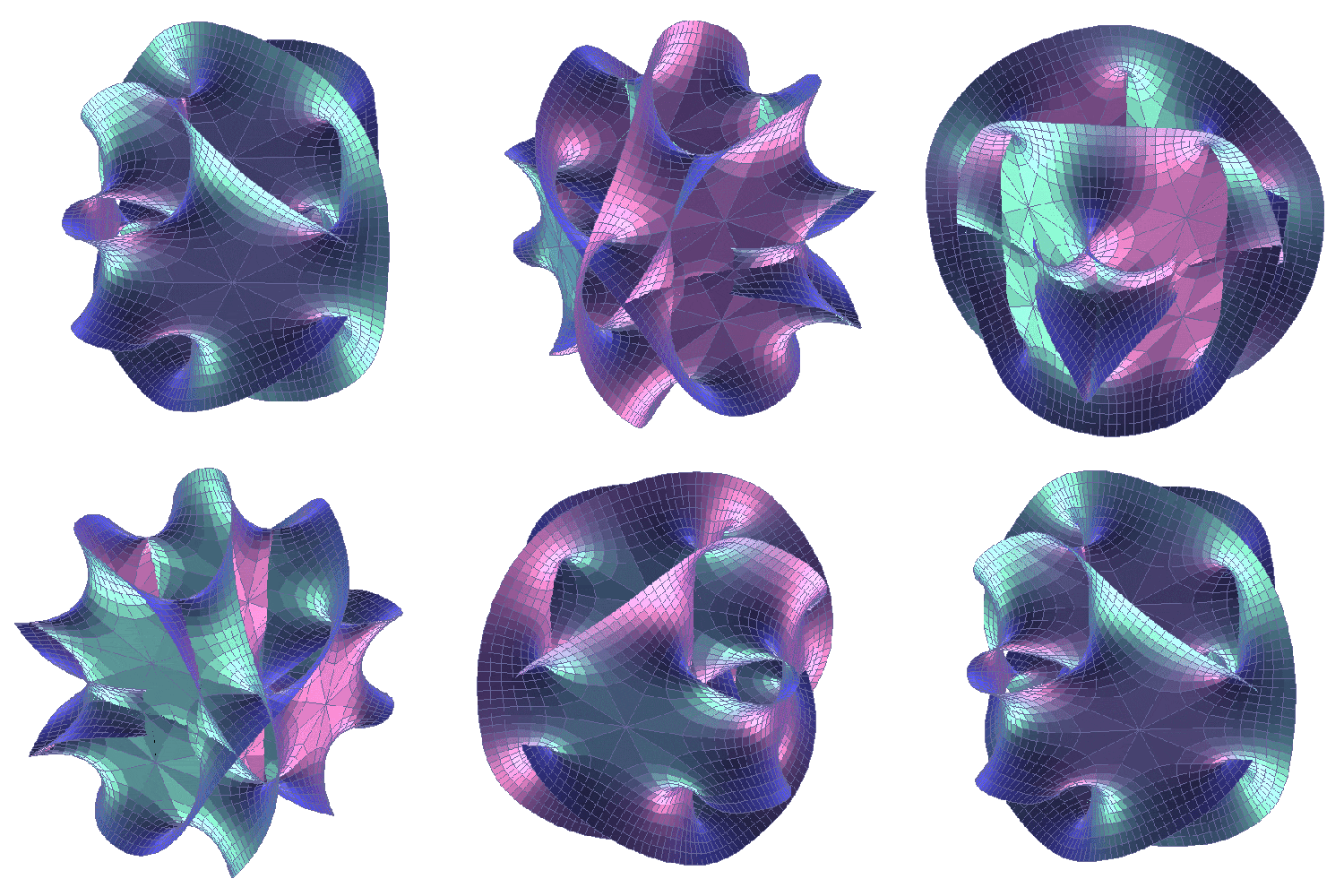
The extra dimensions predicted by string theory, without which every attempt to calculate possibilities in the quantum level results to gibberish, are compacted in Calabi-Yau manifolds (or spaces). You can find some schemes representing them here and here. Keep in mind that the actual Calabi-Yau manifolds are not at all like the images you'll find on the internet: they are 6-dimensional spaces, so they can't be depicted in a two-dimensional surface. That would be like trying to represent three-dimensional space on a line. But such images are enough for you to get the point: Calabi-Yau manifolds are intricate structures.
The extra dimensions can be compacted within a Calabi-Yau manifold in thousends of ways, each of them representing another universe, but there should be only one type of them in ours. Physicists hope that they will find out which of them our universe contains, and expect it to have some particular properties. For instance, three holes via which the three groups of elementary particles of our universe are being created -something that not only diminishes the number of possible manifolds our universe can have, but gives an answer to why are there only three groups of particles.
Unifying quantum mechanics and relativity
But how does this theory unify quantum mechanics and the theory of relativity? As we explained in the beginning, all attemps to unify these exact opposite theories, have failed. In the beginning it wasn't a big deal for physicists, since they could neglect the impact of gravity in the sub-atomic level, as they neglected the quantum fluctuations' impact to large objects. But we need a quantum approach of gravity to explain phenomena such as the black holes' singularities. After all, using two distinct theories, inconsistent to each other, to predict the future of the universe or explain phenomena is a sign that something with your perception of the universe is wrong. And whenever physicists tried to unify these theories and make predictions, the results they got where... infinities. That's not a surprise, since quantum mechanics and relativity describe the universe in different ways, and even fundamental concepts like "space", are defined differently by each of them.
The relativity considers space to be flat, at least in absence of exists. The slightest presence of mass distorts it. Think of a flat surface -a well "made", flat bed sheet, for instance. If we placed a relatively massive object on it, such as a basketball, it wouldn't be flat anymore: its' mere presence would cause a distortion, deepening the bed sheet on the point where we placed it. If we placed then a tennis-ball near the basketball, it would roll towards it as if being pulled by a mysterious force. According to relativity, the exact same thing happens with massive objects within spacetime: the distortion caused by their mass is what pulls objects towards them, and not a bizzare force transmitted instantaneously, as Newton considered gravity to be.
For Einstein's theory, if there's no mass at a spacetime's point, it's entirely flat even at the subatomic level. For quantum mechanics, on the other hand, spacetime seems to be flat in absence of mass, but if we take a look in the quantum world, what we'll see is a mess of particles and anti-particles appearing and disappearing along with energies coming out of nowhere, distoring spacetime. It may sound nonsense: common sense tells us that no matter in how many little pieces will one "cut" spacetime, each of them will be flat and predictable, with no particles emerging out of the empty space. But, as we elaborated, what common sense tells us may be wrong when it comes to science.
One of the most funtamental principles of quantum mechanics is the uncertainty principle. According to it, one can not know both the position and velocity of a particle with 100% precision. The more certain one is for the one, the less certain one is for the other. If you manage to have a particle "trapped" in a small bit of space to be certain for its' position, you won't be able to predict its' velocity, which could be changed to any number in an infinite range of values.
What happens with particles happens with bits of spacetime as well: the smaller the bit, the more intense and unpredictable quantum fluctuations on it. In levels smaller than Planck's, those fluctuations (the Wheeler's "quantum foam") distort spacetime devastatingly. Despite relativity's predictions, spacetime is not flat in the quantum level, and if we tried to measure the quantum fluctuations of an infinitely small spacetime piece we would find out they are infinitely intensive, thanks to the uncertainty principle.
Why are quantum fluctiations a problem? Well, the mere existence of fluctuations itself is not a problem: the way physicists think of elementary particles is what makes things difficult. Most people, when hearing about electrons, imagine extremely small ball-shaped pieces of matter revolving around atomic nucleii. Physicists tried to develop models that considered particles as if being indeed ball-shaped, but failed due to... uhm... technical problems.
The standard model of particle physics, for simplicity's sake, treats particles as point-like objects -that means, mere points, having no dimensions and size. Though it make sound nonsense as well (how can zero-sized objects form anything when combined?), it works fine and predicts experimental results precisely. What makes a theory reliable is its' ability to predict and explain such results, and not how it may sound. Since this model worked fine from the beginning, physicists had no reason to reject it because of its' approach to particles.
(Some of you may wonder: couldn't the consideration of strings as single-dimensional objects, that have only length, be nonsense as well? It could. But the M-theory, which relates string theories with each other, predicts multi-dimensional objects as well)
Physicists had been seeking for a quantum approach of gravity based on the standard model of particle physics and treating particles as zero-dimensional point-like objects. But, thanks to the uncertainty principle, such objects would be very much affected by the quantum fluctiations in the smaller-than-Planck's-length sized pieces of spacetime, making the unification of relativity and quantum mechanics impossible.
The supersymmetric string theory avoids those fluctuations by claiming that the strings are longer or just about 10^-33 cm, and therefore the fluctuations of infinitely small bits of spacetime have no direct impact on them, just like mere quantum fluctuations don't affect whole stars. It doesn't even have a meaning talking about such levels since the most elementary compounds of the world surrounding us are not being affected by them. Therefore, the infinite distortion of spacetime in such levels can be neglected.
Besides the infinite distortion of spacetime, string theory allows us to neglect the infinities of singularities. According to it, no singularity can zero-sized, and therefore there is no literally infinite distortion of spacetime around them. The distortion of spacetime around an object depends on its' density. One can calculate the density of an object dividing its' mass by its' size. If we compressed, let's say, a potato, with a mass of 0.1kg infinitely, making its' size no bigger than a point of spacetime, we would have created a singularity -an object of infinite density. All numbers divided by zero give us an infinite result! But since in string theory no object can have size smaller than 10^-33 cm, we may have a huge distortion of spacetime around a singularity, but it's definitely not infinite. No infinities resulting by divisions by zero exist in string theory.
Though the restriction of what fluctuations should we keep in mind when working with particles may seem enough, there's another way via which string theory unifies them.
One of the most fundamental principles of relativity is that two observers moving in high speed, do not agree on the exact point and moment of an event that took place: what each of them observed depents on the way and speed of their movement. This principle applies to the quantum level as well, when described by the string theory. If, for instance, two observers watched the collision of two strings, they wouldn't agree on where and when they collided with each other: their description of the event would differ, thanks to the their movement, just like relativity predicts!
String dualities
So, there are several good reasons for which string theories are the best canditate theories of everything. First of all, they all predict graviton. All string theories, supersymmetric or not, not only predict gravitons, but one just can't get rid of them: you can't have a string theory without particles with the properties of gravitons, just as you can't have a universe like ours with no gravity. Besides, string theories unify relativity and quantum mechanics by making the infinite distortion of spacetime disappear, and applying to the quantum world all principles of relativity. Last but not least, they intepret our universe using the same maths and principles -the most important feature of a theory of everything- and gives an answer to why is our universe as it is. Physicists, until recently, treated particles as if being made of different materials and where their properties came from remained a question. String theories claim that all particles, no matter the type, are merely vibrating strings, made of the same material, and that their properties are as they are because they couldn' be else.
Physicists would be satisfied even if a theory of everything just compined relativity and quantum mechanics, even if it didn't explain why are particles' properties as they are. After all, that was what the whole research was about -the development of a quantum approach of gravity. String theories are better that what physicists were seeking for. However, while developing the theory, they encountered a huge problem: supersymmetry could be induced in it with five different ways, resulting to five distinct theories. Yet we can have only one theory of everything! Were all of them wrong? If not, which of them was about our universe?
Each of them describes a slightly different cosmos, and even if the differences aren't that big, what scientists seek for a theory of everything for our universe, completely consistent with the laws ruling it. These theories were different in details such as the type of strings and how they interract. There are five consistent suppersymmetric string theories.
1. Type I
In this theory string can be either open or close. The symmetry group used is SO(32).
2. Type IIA
This one containes mostly close strings, and the open ones are bound to D-branes,. Strings vibrate symmetrically and the direction of their vibration's waves is of no significance. The symmetry used is SO(32)
3. Type IIB
Same with the IIA, but the direction of vibration plays its' role.
4. Heterotic-E
The symmetry group used in this is E8xE8. This version of string theory contains close strings only, which, when their vibrational waves move towards left, behave like the ones of the bosonic string theory and if they move toward right, like the ones of type IIB.
5. Heterotic-O
Same with heterotic-E, but the symmetry group is SO(32)
The reason for which no string theory contains open strings only is, as we have explained, that the collision of two open strings can result to a closed one. Closed trings can be created via a procedure resembling of cellular mitosis (strings tore in two pieces) as well. But, no matter how are they being created, one can't get rid of them.
In the beginning it seemed that there were five distinct theories but physicists soon realised they are related via dualities. There are two ways to relate these five theories with each other: T-dualities and S-dualities. T-dualities relate the physics describing universes with compact dimensions of an R radius, to the ones' of universes with dimensions of an 1/R radius.
Strings don't get their energies by vibrating inside of the extra-dimensions only, but by getting wraped around them as well. For instance, consider a two-dimensional universe with a compact third dimension. Strings in this universe would be able to wrap around the third dimension. In this case, would get their total energies by the combination of energies needed to both vibrate and wrap around these dimensions. If there were two parallel universes and the one had a compact dimension with a radius equal to 10 times the Planck's length, while the other a dimension with a radius exactly 10^-33 cm, the total energies of strings vibrating inside them would be equal! And since the physical laws of a universe depend on their strings' energies, then, besides measuring the compact dimensions' radius, there would be no way to distinguish the two universes!
This type of duality is the T-duality and relates heterotic-O with heterotic-E, and type IIA with type IIB. Besides this, there is another way to relate string theories with each other: the S-duality. The S-duality is more complicated... We can define it as the type of duality which relates string theories that have a large coupling constant, with those that have a small one. What exactly do we mean?
The coupling constant is a value regarding the possibility of having a string split and then once again united. The possible values are between 0 and 1 or, if expressed as a percentage, 0 and 100. When making predictions regarding the quantum world using the string approach, physicists use the perturbation theory to solve the maths needed. That means, they first find out the approximate solution of a problem, and then try to make it as precise as possible by adding more parameters.
If the coupling constant of a string theory is equal or bigger than 1 -if, in other words, it's strongly coupled- perturbation theory cannot be used, because in such case, any approximate solution would be wrong. The reason is that if one used the perturbation theory to make the solution more precise, the parameters added would significantly change it -a sign that the previous one was wrong.
When a string theory is strongly coupled, one has to keep in mind all possible splits and collisions of strings in a given system when trying to predict its' outcome, since each of them is needed to find out a precise solution. But in the quantum level, the possibilities are limitless! That makes it impossible for someone to predict an outcome precisely using a strongly coupled theory. At least, when using perturbation theory... Physicists have developed other methods to overcome the particular problem, making it possible for someone to find out approximate solutions.
The S-duality relates strongly coupled string theories with the weakly coupled ones -the ones in which one can use the perturbation theory and doesn't have to keep in mind the infinite number of possible splits and collisions of strings. Universes described by string theories related by the S-duality, are indistinguishable from each other, since the physical laws of them are technically the same. This particular duality relates type I string theory with heterotic-O, as well type II with themselves. That means, either a type IIA or IIB string theory is strongly or weakly coupled, it describes the same cosmos.
So, while in the beginning it seemed that there were five different theories of everything, it was proved that they are all aspects of one and only. The dualities of string theories are the following:
Heterotic-E and Heterotic-O via T-duality
Type IIA and type IIB via T-duality
Type I and Heterotic-O via S-duality
Strongly coupled type IIB with weakly coupled IIB, via S-duality.
The period when these dualities were discovered is nowadays known as the second superstring revolution and showed the path leading to the best candidate theory of everything, the M-theory.
The M-theory
Before the second superstring revolution, all versions of string theory were treated as distinct theories -each of them as a whole unexplored planet. But it was proved that they were merely aspects of one theory only -more like lands of a particular planet, rather than planets themselves. The discovery of their dualities was, indeed, a huge step; before that, physicists were about to believe that they had developed five theories of nothing, instead of a theory of everything. But the greatest progress with string theories during the second superstring revolution, wasn't the discovery of their dualities.
We can consider each string theory as an island of a whole planet. This planet is the M-theory. "M" stands for "Mother", "Magic", "Mystery" or "Membrane", depending on whom will you ask. It is highly likely that this theory, when completed, will be the theory of everything. It is not yet fully developed and its' exact structure remains unknown. There is, however, an approximate version of it, and some of its' features where known since the very beginning.
Its' development started during the second superstring revolution, when suggested by Edward Witten that we can use an 11th dimension to unify string theories, creating a theory-network allowing us to use them interchangeably. One of its' main principles is that, in addition to strings, there are membranes that can give born to particles. These membranes can be of 0 to 10 dimensions.
There are two types of membranes predicted by M-theory, p-branes and D-branes. D-branes are special types of p-branes. We can place the number of the membrane's dimensions instead of p or D. A nine-dimensional p-brane is a 9-brane, a four dimensional D-brane is a 4-brane etc. Each membrane has attributes such as its' charge and tension, which affects the degree to which they are affected by quantum fluctuations and whether they interract with other membranes or not.
M-theory's branes seemed to be necessary in string theories as well, but physicists believed that the problems arising due to the existence of strings only, would have been solved by the time they'd have a fully developed string theory. One of those problems, for instance, was that type I theory's open strings seemed to be bounded to branes instead of simply vibrating. One other was that several particles just couldn't be created by mere string vibrations. All problems of this kind could be solved if we considered membranes to be part of the quantum world along with strings: open strings would be bounded to p-branes and they would be essential for particles' existence. The number of branes' dimensions would be of no concern -an open string would be able to bound to a 5-brane one the one end, and a 0-brane on the other. A p-brane would be able to wrap itself around a spacetime's point, leading to the creation of a particle.
The M-theory relates all string theories with each other, and related each of them with supergravity theories as well. Supergravity theories were the result of physicists' attempts to construct models that induce supersymmetry to a quantum version of Einstein's relativity. It was difficult to prove or disprove them, and for various reasons -with superstring revolution being one of them- physicists abandoned the attempt to complete them. However, they seem to be related to string theories.
Just like general relativity, supergravity can be applied to universes with any number of spatial dimensions. The most promising supergravity theories were the ones applied to 10 and 11-dimensional universes. And, just like string theory, they could have supersymmetry induced to them in several ways. One could have four distinct supergravity theories describing a 10-dimensional universe. Type IIA, IIB and Heterotic-E string theories, when applied to low-energy systems in which we can treat particles as point-like, match to three of them. Type I and Heterotic-O string theories applied to the same energies are almost the same with the fourth one.
Type IIA and Heterotic-E, when strongly coupled, have an eleventh dimension which makes strings look like two-dimensional membranes. In such cases they resemble to the 11-dimensional supergravity theories. The reason for the relations of string and supergravity theories is that they are all aproaches of the theory of everything. The only things we are sure about, when it comes to this theory, is it contains membranes and an 11th dimension. But why should they be 11 instead of 10 or 12? Well, an 11-dimensional theory of everything can unify all string theories. But besides their unification, 11 is the maximum number of dimensions for which we can have a consistent quantum approach of gravity, and the least for which we can induce gravity to a theory including all gauge symmetries of the standard model.
Just like supergravity theories are approaches of string theories, when applied to low-energy systems, string theories are approaches of the M-theory. The M-theory "network" contains another model, called the F-theory. It was developed by Cumrun Vafa and is, essentially, the type IIB applied to a 12-dimensional universe. Though it couldn't be a consistent theory of everything due to its' number of dimensions, it still is an aspect of the M-theory.
A theory of everything or a theory of nothing?
Time will reveal. As we said, how reliable a theory is, depends on its' precision when making predictions on experiments' outcomes. But what are the predictions made by M-theory, anyway? Though there are several ways to prove or disprove it, they are way beyond our current abilities. Most M-theory's predictions regard the sub-atomic level. But there are some discoveries that, if made, will be sings that the M-theory may be correct.
Something that will be a good precursor to the reliability of string and M-theory, is the existence of superpartners. As we previously mentioned, the main requirement of string, and therefore M-theory, to be true, is the existence of supersymmetry in nature -the type of supersymmetry that relates bosons with fermions. It seems that supersymmetry has broken, in a way that superparners have a mass thousands of times greater than the protons'. That means that we need particle accelerators working in extremely high energies to confirm their existence.
Sources
The elegant universe, Brian Greene
String theory for dummies, Andrew Zimmerman Jones - Daniel Robbins, For Dummies
The little book of string theory, Steven Gubser, Princeton University Press
http://www.physics4u.gr/
http://www.openquestions.com/
wikipedia.org
http://superstringtheory.com/
http://www.sukidog.com/jpierre/strings/
--------------------------------------------------------------------------------
Written by George M.
©All rights reserved
I don't mind you reposting in, but keep in mind that I will sue whoever will use it to make profit without refering to this blog.
I would be glad to get informed about any mistakes and have them corrected. :)
-------------------------------------------------------------
Seeking for a theory of everything
Over the last decades, physicists have been seeking for a theory of everything, a theory via which the existence of all kinds of forces and material in our universe will be explained in the same context, emerging from some fundamental equations and laws. Some experts consider such a theory to be non-existent. On the other hand, physicists, while trying to find a theory of everything, have developed theories that seem to not only interpret nature in all its' levels using the same maths, but reply to one of the most critical questions of physics, and mankind in general: why is nature as it is? Pure luck, some kind of superior power working in mysterious ways or it just couldn't be different?
Most attempts to develop a theory of everything failed dismally. The problem with such a theory is that the cornerstones of physics, quantum mechanics and theory of relativity, are utterly inconsistent with one another but a theory of everything has to unify them. Quantum mechanics is about the sub-atomic level while the theory of relativity is a model regarding the behaviour of large-scale cosmic structures and space-time. Both theories make highly precise predictions and are sufficient for what they regard -quantum mechanics the behaviour of subatomic particles and the interractions between them and relativity the way spacetime is affected by massive objects, along with how massive objects influence one another.
The standard model of particle physics explains the influence of all forces in the subatomic level, except gravity's. That's not a big issue for physicists: gravity is not an influential force in that level and they can neglect it when trying to predict an experiment's outcome, without getting different results than expected due to it. However, if a phenomenon takes place in extremely high energies, then gravity plays its' role too. If we want to predict the behaviour of particles in high energies and explain phenomena like the black holes' singularities, where colossal gravitational waves are being created by smaller-than-particle-sized spacetime points, we have to develop a theory which unifies quantum mechanics and relativity -a theory of everything.
It's not exactly a surprise that those theories have not been unified despite the decades-lasting research: one is the exact opposite of another. The one is, as we mentioned, about gravity and large-scale structures, such as star-clusters and galaxies. The other is about sub-atomic particles. The one treats spacetime as being smooth where no massive objects exist and the other considers spacetime to be foamy and constantly distorted by quantum fluctuations, which become colossal in points of space with size near Planck's length (10^-33 cm). The one claims that universe is a predictable place, that we can find out which its' future is if we keep in mind all parameters needed, while the other wants it to be unpredictable, in which everything is possible to happen and we can only predict the propability of an act to take place.
A theory of everything has to modify quantum mechanics and relativity so that their unification will be feasible, but in a way that we'll still be able to make precise predictions for the universe. The only theories that seem to be theories of everything is the loop quantum gravity and the string theory. The current article will focus on the second one, which's elegance has made most physicists to consider as the theory of everything or, at least, the lane leading to the theory of everything.
String theory - From bosonic to supersymmetric
The most fundamendal principle of string theory is that particles are not point-like as in the standard model, but extremely small strings vibrating in different ways, behaving like particles with various properties.
The development of string theory began in 1968, when the Italian physicist Veneziano was struggling to find out why the results of an experiment in CERN about strong interractions between particles, were as they were. He noticed that a particular equation known as Euler's Beta function described precisely the strong interractions, if one assumed that particles were single-dimensioned vibrating strings instead of point-like.
But quantum chromodynamics seemed to describe strong interractions better than Veneziano's model -which, after all, was a rather unstable one, collapsing each time a parameter was slightly changed. Though it seemed that Veneziano's approach was proved wrong, some physicists gave it a second chance trying to further develop it.
By 1974 the first type of string theory -known as bosonic or type 0- had been completed. The bosonic string theory was a mathematical mess and there was no way that it could describe the universe we live in. First of all, it required 26 dimensions to work properly -25 spatial and time. But our universe has just four (or so it seems)! That thing and only was enough to sent to trash all the efford made to complete the theory. But beside dimensions, many things were wrong with that theory. It predicted the existance of bosons (particles of energy) only, and no fermions (material particles). That means, the theory described a universe in which there were only forces and no material. One of those bosons was the tachyon, which was supposed to move with greater speed than the light's.
It was apparent that the particular theory was just abstract mathematics describing a peculiar universe, and therefore there was no reason for physicists to lose their time with it. But there was something that impressed them: the bosonic string theory predicted gravitons, the supposed boson of gravity. Even though we have still not observed these particles in nature, we know what their characteristics are, for instance spin-2 and zero mass. The theory predicted a boson with those exact properties, which couldn't be other than the graviton.
It arised that if we use supersymmetry -a type of symmetry which connects fermions and bosons in a way that for each boson there's a fermion and vice versa- in the bosonic string theory the number of dimensions reduces to 10, there are fermions along with bosons and particles like the tachyon disappear.
When one talks about the string theory since, one means the supersymmetric and not the bosonic one, which now is only of mathematical interest and no physicists work on it anymore. The biggest problem of supersymmetry is that it predicts the double number of particles observed until nowadays: since each boson is matched to a particular fermion, the particles we've seen should be somehow related to each other but they don't seem to be connected in any way. Therefore, if suppersymmetry exists in nature, we have observed only half of the existent particles.
Why haven't we observed the others? The extra particles required by suppersymetry to be correct -known as superpartners- seem to have a huge mass, compared to the observed ones. That means, one has to do experiments in extremely high energies to observe superpartners, due to the relation of mass and energy. But why should we consider supersymmetry to be correct? Couldn't it exist only in mathematics, having no role in nature and being something that won't be included in a real theory of everything? It definitely could. But physicists have some good reasons to treat supersymmetry as a realistic hypothesis.
There are four forces in nature: the gravitational, the electromagnitic, the weak and the strong nuclear. They are not equally powerful. Strong nuclear, for instance, which keeps quarks bound together in neutrons and protons so powerfully that no single quark exists in nature, and is the reason for which the atomic nucleii don't dissolve by themselves, is incombarably more powerful than gravity. But when in extreme energies (such as in the big bang) the power of those forces become equal. Without suppersymmetry they are almost equally powerful in such cases. With supersymmetry have exactly equal power. And several technical problems the standard model has, disappear when we include supersymmetry in its' equations. For these reasons, along with the fact that a potential theory of everything needs supersymmetry to work, many physicists find it difficult to believe that such an elegant symmetry doesn't exist in nature.
In (supersymmetric) string theory, particles are nothing more than one-dimensional strings vibrating in different ways, with their various properties depenting on the way the vibrate. The length of those strings is about equal to Planck's (10^-33 cm). They can be either "open", like hair, or "closed", like circles, depenting on the type of string theory. Soon we will explain how supersymmetry can be applied to string theory in 5 different ways, creating 5 discrete theories. Though all of them seem to describe our universe, they are different from each other at some points. There are not huge differences between them, but since there can be only one theory of everything, some (or all) of them have to be wrong! Five theories of everything can only regard five different universes! We will see that each of those theories is merely a lane leading to the theory of everything, which is named the M-theory. But we have first to see another aspect of string theories', which, if proved to be true, will change our perception of the universe more than any theory ever did.
Extra dimensions!
Each string theory has either closed or both open and closed strings. The reason for which no string theory includes open strings only is that the collision of two of them can lead to the creation of a closed one. Strings, no matter what they look like, vibrate in 10 dimensions -9 spatial and time. But how can they vibrate in so many dimensions since our universe has just 3? What are those extra dimensions string theory predicts?
We, humans, are familiar only with the three spatial dimensions we live in. But when it comes to science, what we're familiar with has nothing to do with how things actually are. We are, for instance, familiar with a star rising from the east, shining above our heads several hours, and then sinking somewhere in the west. Same with the sky: our perception tells us that the sky revolves around the earth, which is immovable. But thanks to science, even a child knows they're both just illusions: it's the earth that revolves making the sun appearing to humans as if being the moving object, and it's the earth's movement around the sun that makes sky looking different each season.
One can find in physics countless examples of how our perception decieves us. One of them is the illusion that time is everywhere the same, no matter the gravity and speed in which one moves. Einstein proved that even when it comes to time, our perception is wrong. Fortunately or not, either due to our position in the universe, or our size, or even our cognition, we have a distorted image of the nature and the universe. And we may be wrong even about the amount of dimensions in existence.
Three years after relativity's publication, German mathematician Theodor Kaluza sent Einstein an essay, concordant to which if we apply general relativity in a five-dimensional (time and four spatial dimensions) universe, the equations emerging resemble to Maxwell's electromagnetic theory. It seemed that, somehow, gravity and electromagnetism "met" each other in a forth dimension. But how could these forces be united in our universe? A couple of years after the publication of the essay, Klein suggested that there could be a fourth spatial dimension in our world, in a form that it wouldn't directly affect it, being impossible for large objects to move through it. This suggestion is nowadays known as the Kaluza-Klein hypothesis.
The hypothesis that our universe may have more dimensions than we see was revolutionary, and sounded bizzare that era. Nobody had assumed such thing before (at least, as far as we're concerned) and since there was no evidence for the existence of a forth dimension and no way to prove or refute the hypothesis, scientists avoided it. After all, those were the years quantum mechanics' development began, and they had more... important things to do than proving Klein wrong. But nowadays the provement or disprovement of the existance of more dimensions is a huge challenge for physicists, because a potential theory of everything predicts them. Four of the dimensions predicted by string theory are the ones we're familiar with. The others are in a compact form, as Klein assumed about the forth dimension.
But what do we mean when talking about compact dimensions? Imagine a rope tied on the trunk of two trees facing each other. If observed from a far away, it would look like it was single-dimensioned, having only length and no width. But if observed from a shorter distance, the existance of width would become apparent, and if some tiny insect walked towards it, it would go back to the starting point. If instead of a rope we had hair, it would be more difficult to observe the width. That's what a compact dimension is like. It's not observable when we are away, but if we, somehow, get close, its' existance will become apparent. According to string theory, the extra dimensions are part of our universe, but aren't detectable even by the most powerful systems available, and don't have a direct influence in our lives.
The extra dimensions of string theory are everywhere, on every single point of the universe. And just as if we lived in a two-dimensional world with a third dimension being compact, we would be moving on it without ever realising it, we move through these dimensions never noticing it. But why are they so important for string theory to work? Couldn't the same theory be applied to a four-dimensional universe? And why there are only 3 "expanded" spatial dimensions and the others are compact?
There isn't a perticular answer to the second question. Physicists hope that they'll find it out when the M-theory will have been completed, but for the moment there are only some suggestions about why are only three dimensions expanded. It's been suggested, for instance, that the universe may have been 10-dimensional during its' first moments after the big bang, but was unstable, and its' expansion made 6 of those dimensions collapse to themselves. And that in extremely high-energies we could make them expand, while the four forces of nature would become equally powerful! String theory will change our perception of the universe radically, if proved.
The prediction of extra dimensions predicted by this theory is one of its' most impressive features. But why are they so important? Can't string theory work without them? Couldn't we have strings vibrating in a four-dimensional universe? When using quantum mechanics, as we previously mentioned, one can only predict the propability of an event to happen. These propabilities are at least zero, and at most a hundred. If we want a propability to make sense, it has to be within these limits, -what would a 150% propability of something to take place mean?
Whenever one uses quantum mechanics replacing point-like particles with strings vibrating in three spatial dimensions, the resulting propabilities are negative, and remain negative until one raises the number of dimensions to nine. The more we increase the number of dimensions, the less propabilities result to negative. Inevitably, we can't apply the string model in less than nine spatial dimensions.
The extra dimensions predicted by string theory, without which every attempt to calculate possibilities in the quantum level results to gibberish, are compacted in Calabi-Yau manifolds (or spaces). You can find some schemes representing them here and here. Keep in mind that the actual Calabi-Yau manifolds are not at all like the images you'll find on the internet: they are 6-dimensional spaces, so they can't be depicted in a two-dimensional surface. That would be like trying to represent three-dimensional space on a line. But such images are enough for you to get the point: Calabi-Yau manifolds are intricate structures.
The extra dimensions can be compacted within a Calabi-Yau manifold in thousends of ways, each of them representing another universe, but there should be only one type of them in ours. Physicists hope that they will find out which of them our universe contains, and expect it to have some particular properties. For instance, three holes via which the three groups of elementary particles of our universe are being created -something that not only diminishes the number of possible manifolds our universe can have, but gives an answer to why are there only three groups of particles.
Unifying quantum mechanics and relativity
But how does this theory unify quantum mechanics and the theory of relativity? As we explained in the beginning, all attemps to unify these exact opposite theories, have failed. In the beginning it wasn't a big deal for physicists, since they could neglect the impact of gravity in the sub-atomic level, as they neglected the quantum fluctuations' impact to large objects. But we need a quantum approach of gravity to explain phenomena such as the black holes' singularities. After all, using two distinct theories, inconsistent to each other, to predict the future of the universe or explain phenomena is a sign that something with your perception of the universe is wrong. And whenever physicists tried to unify these theories and make predictions, the results they got where... infinities. That's not a surprise, since quantum mechanics and relativity describe the universe in different ways, and even fundamental concepts like "space", are defined differently by each of them.
The relativity considers space to be flat, at least in absence of exists. The slightest presence of mass distorts it. Think of a flat surface -a well "made", flat bed sheet, for instance. If we placed a relatively massive object on it, such as a basketball, it wouldn't be flat anymore: its' mere presence would cause a distortion, deepening the bed sheet on the point where we placed it. If we placed then a tennis-ball near the basketball, it would roll towards it as if being pulled by a mysterious force. According to relativity, the exact same thing happens with massive objects within spacetime: the distortion caused by their mass is what pulls objects towards them, and not a bizzare force transmitted instantaneously, as Newton considered gravity to be.
For Einstein's theory, if there's no mass at a spacetime's point, it's entirely flat even at the subatomic level. For quantum mechanics, on the other hand, spacetime seems to be flat in absence of mass, but if we take a look in the quantum world, what we'll see is a mess of particles and anti-particles appearing and disappearing along with energies coming out of nowhere, distoring spacetime. It may sound nonsense: common sense tells us that no matter in how many little pieces will one "cut" spacetime, each of them will be flat and predictable, with no particles emerging out of the empty space. But, as we elaborated, what common sense tells us may be wrong when it comes to science.
One of the most funtamental principles of quantum mechanics is the uncertainty principle. According to it, one can not know both the position and velocity of a particle with 100% precision. The more certain one is for the one, the less certain one is for the other. If you manage to have a particle "trapped" in a small bit of space to be certain for its' position, you won't be able to predict its' velocity, which could be changed to any number in an infinite range of values.
What happens with particles happens with bits of spacetime as well: the smaller the bit, the more intense and unpredictable quantum fluctuations on it. In levels smaller than Planck's, those fluctuations (the Wheeler's "quantum foam") distort spacetime devastatingly. Despite relativity's predictions, spacetime is not flat in the quantum level, and if we tried to measure the quantum fluctuations of an infinitely small spacetime piece we would find out they are infinitely intensive, thanks to the uncertainty principle.
Why are quantum fluctiations a problem? Well, the mere existence of fluctuations itself is not a problem: the way physicists think of elementary particles is what makes things difficult. Most people, when hearing about electrons, imagine extremely small ball-shaped pieces of matter revolving around atomic nucleii. Physicists tried to develop models that considered particles as if being indeed ball-shaped, but failed due to... uhm... technical problems.
The standard model of particle physics, for simplicity's sake, treats particles as point-like objects -that means, mere points, having no dimensions and size. Though it make sound nonsense as well (how can zero-sized objects form anything when combined?), it works fine and predicts experimental results precisely. What makes a theory reliable is its' ability to predict and explain such results, and not how it may sound. Since this model worked fine from the beginning, physicists had no reason to reject it because of its' approach to particles.
(Some of you may wonder: couldn't the consideration of strings as single-dimensional objects, that have only length, be nonsense as well? It could. But the M-theory, which relates string theories with each other, predicts multi-dimensional objects as well)
Physicists had been seeking for a quantum approach of gravity based on the standard model of particle physics and treating particles as zero-dimensional point-like objects. But, thanks to the uncertainty principle, such objects would be very much affected by the quantum fluctiations in the smaller-than-Planck's-length sized pieces of spacetime, making the unification of relativity and quantum mechanics impossible.
The supersymmetric string theory avoids those fluctuations by claiming that the strings are longer or just about 10^-33 cm, and therefore the fluctuations of infinitely small bits of spacetime have no direct impact on them, just like mere quantum fluctuations don't affect whole stars. It doesn't even have a meaning talking about such levels since the most elementary compounds of the world surrounding us are not being affected by them. Therefore, the infinite distortion of spacetime in such levels can be neglected.
Besides the infinite distortion of spacetime, string theory allows us to neglect the infinities of singularities. According to it, no singularity can zero-sized, and therefore there is no literally infinite distortion of spacetime around them. The distortion of spacetime around an object depends on its' density. One can calculate the density of an object dividing its' mass by its' size. If we compressed, let's say, a potato, with a mass of 0.1kg infinitely, making its' size no bigger than a point of spacetime, we would have created a singularity -an object of infinite density. All numbers divided by zero give us an infinite result! But since in string theory no object can have size smaller than 10^-33 cm, we may have a huge distortion of spacetime around a singularity, but it's definitely not infinite. No infinities resulting by divisions by zero exist in string theory.
Though the restriction of what fluctuations should we keep in mind when working with particles may seem enough, there's another way via which string theory unifies them.
One of the most fundamental principles of relativity is that two observers moving in high speed, do not agree on the exact point and moment of an event that took place: what each of them observed depents on the way and speed of their movement. This principle applies to the quantum level as well, when described by the string theory. If, for instance, two observers watched the collision of two strings, they wouldn't agree on where and when they collided with each other: their description of the event would differ, thanks to the their movement, just like relativity predicts!
String dualities
So, there are several good reasons for which string theories are the best canditate theories of everything. First of all, they all predict graviton. All string theories, supersymmetric or not, not only predict gravitons, but one just can't get rid of them: you can't have a string theory without particles with the properties of gravitons, just as you can't have a universe like ours with no gravity. Besides, string theories unify relativity and quantum mechanics by making the infinite distortion of spacetime disappear, and applying to the quantum world all principles of relativity. Last but not least, they intepret our universe using the same maths and principles -the most important feature of a theory of everything- and gives an answer to why is our universe as it is. Physicists, until recently, treated particles as if being made of different materials and where their properties came from remained a question. String theories claim that all particles, no matter the type, are merely vibrating strings, made of the same material, and that their properties are as they are because they couldn' be else.
Physicists would be satisfied even if a theory of everything just compined relativity and quantum mechanics, even if it didn't explain why are particles' properties as they are. After all, that was what the whole research was about -the development of a quantum approach of gravity. String theories are better that what physicists were seeking for. However, while developing the theory, they encountered a huge problem: supersymmetry could be induced in it with five different ways, resulting to five distinct theories. Yet we can have only one theory of everything! Were all of them wrong? If not, which of them was about our universe?
Each of them describes a slightly different cosmos, and even if the differences aren't that big, what scientists seek for a theory of everything for our universe, completely consistent with the laws ruling it. These theories were different in details such as the type of strings and how they interract. There are five consistent suppersymmetric string theories.
1. Type I
In this theory string can be either open or close. The symmetry group used is SO(32).
2. Type IIA
This one containes mostly close strings, and the open ones are bound to D-branes,. Strings vibrate symmetrically and the direction of their vibration's waves is of no significance. The symmetry used is SO(32)
3. Type IIB
Same with the IIA, but the direction of vibration plays its' role.
4. Heterotic-E
The symmetry group used in this is E8xE8. This version of string theory contains close strings only, which, when their vibrational waves move towards left, behave like the ones of the bosonic string theory and if they move toward right, like the ones of type IIB.
5. Heterotic-O
Same with heterotic-E, but the symmetry group is SO(32)
The reason for which no string theory contains open strings only is, as we have explained, that the collision of two open strings can result to a closed one. Closed trings can be created via a procedure resembling of cellular mitosis (strings tore in two pieces) as well. But, no matter how are they being created, one can't get rid of them.
In the beginning it seemed that there were five distinct theories but physicists soon realised they are related via dualities. There are two ways to relate these five theories with each other: T-dualities and S-dualities. T-dualities relate the physics describing universes with compact dimensions of an R radius, to the ones' of universes with dimensions of an 1/R radius.
Strings don't get their energies by vibrating inside of the extra-dimensions only, but by getting wraped around them as well. For instance, consider a two-dimensional universe with a compact third dimension. Strings in this universe would be able to wrap around the third dimension. In this case, would get their total energies by the combination of energies needed to both vibrate and wrap around these dimensions. If there were two parallel universes and the one had a compact dimension with a radius equal to 10 times the Planck's length, while the other a dimension with a radius exactly 10^-33 cm, the total energies of strings vibrating inside them would be equal! And since the physical laws of a universe depend on their strings' energies, then, besides measuring the compact dimensions' radius, there would be no way to distinguish the two universes!
This type of duality is the T-duality and relates heterotic-O with heterotic-E, and type IIA with type IIB. Besides this, there is another way to relate string theories with each other: the S-duality. The S-duality is more complicated... We can define it as the type of duality which relates string theories that have a large coupling constant, with those that have a small one. What exactly do we mean?
The coupling constant is a value regarding the possibility of having a string split and then once again united. The possible values are between 0 and 1 or, if expressed as a percentage, 0 and 100. When making predictions regarding the quantum world using the string approach, physicists use the perturbation theory to solve the maths needed. That means, they first find out the approximate solution of a problem, and then try to make it as precise as possible by adding more parameters.
If the coupling constant of a string theory is equal or bigger than 1 -if, in other words, it's strongly coupled- perturbation theory cannot be used, because in such case, any approximate solution would be wrong. The reason is that if one used the perturbation theory to make the solution more precise, the parameters added would significantly change it -a sign that the previous one was wrong.
When a string theory is strongly coupled, one has to keep in mind all possible splits and collisions of strings in a given system when trying to predict its' outcome, since each of them is needed to find out a precise solution. But in the quantum level, the possibilities are limitless! That makes it impossible for someone to predict an outcome precisely using a strongly coupled theory. At least, when using perturbation theory... Physicists have developed other methods to overcome the particular problem, making it possible for someone to find out approximate solutions.
The S-duality relates strongly coupled string theories with the weakly coupled ones -the ones in which one can use the perturbation theory and doesn't have to keep in mind the infinite number of possible splits and collisions of strings. Universes described by string theories related by the S-duality, are indistinguishable from each other, since the physical laws of them are technically the same. This particular duality relates type I string theory with heterotic-O, as well type II with themselves. That means, either a type IIA or IIB string theory is strongly or weakly coupled, it describes the same cosmos.
So, while in the beginning it seemed that there were five different theories of everything, it was proved that they are all aspects of one and only. The dualities of string theories are the following:
Heterotic-E and Heterotic-O via T-duality
Type IIA and type IIB via T-duality
Type I and Heterotic-O via S-duality
Strongly coupled type IIB with weakly coupled IIB, via S-duality.
The period when these dualities were discovered is nowadays known as the second superstring revolution and showed the path leading to the best candidate theory of everything, the M-theory.
The M-theory
Before the second superstring revolution, all versions of string theory were treated as distinct theories -each of them as a whole unexplored planet. But it was proved that they were merely aspects of one theory only -more like lands of a particular planet, rather than planets themselves. The discovery of their dualities was, indeed, a huge step; before that, physicists were about to believe that they had developed five theories of nothing, instead of a theory of everything. But the greatest progress with string theories during the second superstring revolution, wasn't the discovery of their dualities.
We can consider each string theory as an island of a whole planet. This planet is the M-theory. "M" stands for "Mother", "Magic", "Mystery" or "Membrane", depending on whom will you ask. It is highly likely that this theory, when completed, will be the theory of everything. It is not yet fully developed and its' exact structure remains unknown. There is, however, an approximate version of it, and some of its' features where known since the very beginning.
Its' development started during the second superstring revolution, when suggested by Edward Witten that we can use an 11th dimension to unify string theories, creating a theory-network allowing us to use them interchangeably. One of its' main principles is that, in addition to strings, there are membranes that can give born to particles. These membranes can be of 0 to 10 dimensions.
There are two types of membranes predicted by M-theory, p-branes and D-branes. D-branes are special types of p-branes. We can place the number of the membrane's dimensions instead of p or D. A nine-dimensional p-brane is a 9-brane, a four dimensional D-brane is a 4-brane etc. Each membrane has attributes such as its' charge and tension, which affects the degree to which they are affected by quantum fluctuations and whether they interract with other membranes or not.
M-theory's branes seemed to be necessary in string theories as well, but physicists believed that the problems arising due to the existence of strings only, would have been solved by the time they'd have a fully developed string theory. One of those problems, for instance, was that type I theory's open strings seemed to be bounded to branes instead of simply vibrating. One other was that several particles just couldn't be created by mere string vibrations. All problems of this kind could be solved if we considered membranes to be part of the quantum world along with strings: open strings would be bounded to p-branes and they would be essential for particles' existence. The number of branes' dimensions would be of no concern -an open string would be able to bound to a 5-brane one the one end, and a 0-brane on the other. A p-brane would be able to wrap itself around a spacetime's point, leading to the creation of a particle.
The M-theory relates all string theories with each other, and related each of them with supergravity theories as well. Supergravity theories were the result of physicists' attempts to construct models that induce supersymmetry to a quantum version of Einstein's relativity. It was difficult to prove or disprove them, and for various reasons -with superstring revolution being one of them- physicists abandoned the attempt to complete them. However, they seem to be related to string theories.
Just like general relativity, supergravity can be applied to universes with any number of spatial dimensions. The most promising supergravity theories were the ones applied to 10 and 11-dimensional universes. And, just like string theory, they could have supersymmetry induced to them in several ways. One could have four distinct supergravity theories describing a 10-dimensional universe. Type IIA, IIB and Heterotic-E string theories, when applied to low-energy systems in which we can treat particles as point-like, match to three of them. Type I and Heterotic-O string theories applied to the same energies are almost the same with the fourth one.
Type IIA and Heterotic-E, when strongly coupled, have an eleventh dimension which makes strings look like two-dimensional membranes. In such cases they resemble to the 11-dimensional supergravity theories. The reason for the relations of string and supergravity theories is that they are all aproaches of the theory of everything. The only things we are sure about, when it comes to this theory, is it contains membranes and an 11th dimension. But why should they be 11 instead of 10 or 12? Well, an 11-dimensional theory of everything can unify all string theories. But besides their unification, 11 is the maximum number of dimensions for which we can have a consistent quantum approach of gravity, and the least for which we can induce gravity to a theory including all gauge symmetries of the standard model.
Just like supergravity theories are approaches of string theories, when applied to low-energy systems, string theories are approaches of the M-theory. The M-theory "network" contains another model, called the F-theory. It was developed by Cumrun Vafa and is, essentially, the type IIB applied to a 12-dimensional universe. Though it couldn't be a consistent theory of everything due to its' number of dimensions, it still is an aspect of the M-theory.
A theory of everything or a theory of nothing?
Time will reveal. As we said, how reliable a theory is, depends on its' precision when making predictions on experiments' outcomes. But what are the predictions made by M-theory, anyway? Though there are several ways to prove or disprove it, they are way beyond our current abilities. Most M-theory's predictions regard the sub-atomic level. But there are some discoveries that, if made, will be sings that the M-theory may be correct.
Something that will be a good precursor to the reliability of string and M-theory, is the existence of superpartners. As we previously mentioned, the main requirement of string, and therefore M-theory, to be true, is the existence of supersymmetry in nature -the type of supersymmetry that relates bosons with fermions. It seems that supersymmetry has broken, in a way that superparners have a mass thousands of times greater than the protons'. That means that we need particle accelerators working in extremely high energies to confirm their existence.
Sources
The elegant universe, Brian Greene
String theory for dummies, Andrew Zimmerman Jones - Daniel Robbins, For Dummies
The little book of string theory, Steven Gubser, Princeton University Press
http://www.physics4u.gr/
http://www.openquestions.com/
wikipedia.org
http://superstringtheory.com/
http://www.sukidog.com/jpierre/strings/
--------------------------------------------------------------------------------
Written by George M.
©All rights reserved


Το πες και το κανες τελικα!
ΑπάντησηΔιαγραφή;)
Διαγραφή